If you’ve got a tree that needs to come down in South Central Indiana – from Bloomington and Bedford, to Greenwood and beyond, you probably want a ballpark figure before calling a service. Most tree removals in our area run $425 to $8,500 per tree, with most homeowners landing somewhere around $1,200 to $3,500. While height is often a factor, risk is as well. You’re not just paying for the tree to come down, you’re paying for the tree to come down safely.
Cost by tree size
- Small (under 30 ft): $425–$1,200. This may include ornamental trees, small maples, small dead trees, or others fellable without heavy equipment.
- Medium (30–60 ft): $1,200–$3,500. This usually includes trees that require controlled cutting, some rigging, moderate cleanup, or additional hauling
- Large (60–80 ft): $3,500–$8,500. Large mature trees like oaks, maples, walnuts, sycamores, and pines often need a lift, climbing, and more crew time.
- Very large/high risk removal (80 ft+): $8,500–$25,000. Major removals include massive trees near houses or power lines, crane work, street closures, or multi-day projects. Costs rise quickly due to higher risk, specialized equipment, and heavier cleanup.

Cost-per-foot vs. flat pricing
Most tree services quote in one of two ways: a flat price after walking the site, or a per-foot rate, typically $9 to $15 per foot of height, with diameter, access, and cleanup added on top. Either approach is normal. But knowing the per-foot math gives you a quick gut check on any bid. A 50-foot tree at $12 per foot lands around $600 before extras. If a quote comes in well above that with no clear reason (power lines, hazard, tough access), it’s worth asking why.
Want a number specific to your tree instead of a range? We offer free estimates, so give us a call or fill out a quick form and we’ll get you an exact quote, no guessing required.
Factors that affect the price
A quote isn’t just about height. Here’s what else goes into the number.
Tree condition
A healthy tree and a dead or storm-damaged one don’t cost the same to remove. But not always in the direction you’d expect.
Dead or diseased trees can sometimes come down faster and cheaper. There’s less concern about preserving nearby landscaping. Still, dead trees are unpredictable. Hollow trunks aren’t always visible from the ground, so a simple-looking removal can turn out more involved once we’re up close.
Storm-damaged or leaning trees usually push the price up instead. Lean can matter more than height, and root failure is often the biggest hazard we’re watching for. Accessibility plays a big role too, since a tricky site adds time and equipment no matter the tree’s condition.
Accessibility & location
A tree standing alone in an open backyard is a different job than one wedged between your house, a fence, and the neighbor’s power line. Tight access means more time, more careful rigging, and sometimes specialized equipment to get pieces down safely. If a crane is the only safe way in, that adds to the cost.
Trunk diameter & number of trunks
Height isn’t the whole story. A short tree with a wide trunk, or one that splits into multiple trunks near the base, takes more cuts and more cleanup than a single straight trunk of the same height. We factor diameter in alongside height when we walk the site.
Lean and fall direction
Which way a tree wants to fall (and what’s in that path) changes how it has to come down. A tree leaning toward open space is usually straightforward. One leaning toward your roof, a fence line, or a neighbor’s property often needs to be taken down in sections rather than felled whole, which adds time and cost.
Emergency vs. scheduled removal
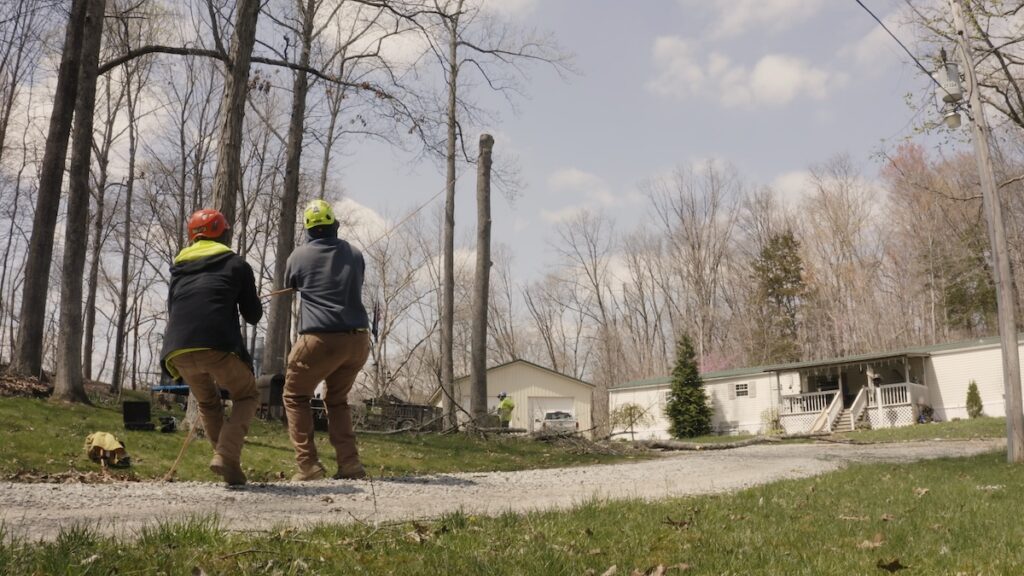
A tree that’s already down (or about to be) after a storm is a different kind of job than one you’ve been planning to remove for a while. Emergency and after-hours removals typically carry a premium, since crews respond quickly, often in worse conditions. If you can schedule the work in advance, it becomes more affordable. Southern Indiana gets hit with its share of storms, so if a tree comes down and you need it removed fast, give us a call and we’ll get to you as quickly and safely as we can.
Add-on costs
The number on your quote is for removing the tree itself. Here’s what else might show up as separate line items.
Stump removal vs. stump grinding
Once the tree’s down, what to do with the stump is a separate question. Stump grinding chews the stump down below grade so you can landscape over it; stump removal pulls the whole root ball out, which costs more but clears the ground completely if you’re planning to replant or regrade that spot. We can quote either. If you just want a quick number, our stump-grinding quote calculator will give you one based on a few measurements.
Log and brush hauling
Removing the tree doesn’t automatically mean it leaves your property. Hauling away the logs, branches, and brush is typically a separate cost from the removal itself, based on volume. If you’d rather keep some of it, just let us know before we start.
Wood chipping or keeping firewood
Branches and smaller limbs usually get run through a chipper on-site, which keeps cleanup fast and leaves you with mulch if you want it. If you’d rather keep the larger pieces as firewood rather than have us haul or chip them, that’s an easy ask and can actually save you a bit on the final bill.
Limb chipping, lot cleanup & travel fees
A full cleanup (chipping limbs, raking up debris, leaving the lot looking like we were never there) is usually included, but it’s worth confirming what “cleanup” means in any quote you get. We also factor in travel time for jobs in Ellettsville, Unionville, Spencer, and other communities we serve outside Bloomington proper.
What to Know Before You Hire
Tree removal permits in Indiana
Here’s some good news: Indiana doesn’t require a state permit to remove a tree on your own private property, and that holds true here in Bloomington, too. The City doesn’t regulate what you do with trees on your own lot.
Where permits do come in is public trees. You might assume a tree on city property isn’t yours to touch, and mostly, that’s right. But if a city tree is in the right-of-way (the strip along the street, between the sidewalk and the curb) or causing a problem on your property, you can apply for a Tree Work Permit through the city.
The same goes if you’re trimming or removing more than 20 percent of a street tree’s canopy with no immediate hazard.
If you’re in Monroe Township specifically, there’s a separate shade tree permit process through the township office, with a modest fee. Requirements can vary by township and by whether you’re inside or outside city limits, so if you’re unsure which one applies to your property, it’s worth a quick call before work starts. We’re happy to help you figure it all out.
Who’s responsible
In Indiana, the general rule is simple: whoever owns the ground the trunk is standing in owns the tree, even if branches reach over the fence into someone else’s yard. Your neighbor can trim back anything hanging over their property line, but they can’t remove the tree itself without your okay.
It gets a little different with boundary trees, ones growing right on the line between two properties. Those count as shared property, so removal needs agreement from both owners. If a tree like that needs to come down, we’d recommend having that conversation with your neighbor before you call us.
Utility-line trees are their own category, too. If a tree is interfering with power lines, the utility company (Duke Energy serves most of the Bloomington area) often handles or coordinates that work directly, sometimes at no cost to you, since it affects their equipment.
Regional price variation
Tree removal costs aren’t flat across Indiana. Bloomington and Monroe County tend to land close to state averages, while rural counties with less competition among tree services see slightly higher quotes simply because crews have farther to travel. Indianapolis and other larger metro markets can run higher, too, driven by demand. If you’re comparing a quote from us against one from out of town, keep in mind you’re not always comparing apples to apples.
Some trees are worth removing even when healthy. In Monroe County, invasive species like Callery pear, tree of heaven, and white mulberry crowd out native trees and cause long-term property issues. MC-IRIS has offered reimbursement assistance for removing certain invasive trees.
DIY vs. hiring a pro
It’s tempting to do it yourself, especially for a smaller tree. For a young sapling well away from your house, that might be reasonable. But tree removal gets dangerous fast: a falling limb, an unexpected lean, or a chainsaw kickback can cause real injury or property damage in seconds.
Factor in the cost of renting the right equipment, and a pro often ends up costing about the same. If a tree is near your house, power lines, or a fence, or if you’d need more than a ladder to reach it, call a pro.
How to read a quote
A fair tree removal estimate should spell out more than just a final number. Here’s what to look for:
- Scope of work. Does it cover the full tree, or just removal down to a stump?
- Cleanup. Is hauling, chipping, and lot cleanup included, or billed separately?
- Insurance and licensing. Is the company covered if something goes wrong on your property?
- Timeline. When will the work actually happen?
- Access notes. Did the estimator account for tight spots, slopes, or nearby structures, or is the price based on a quick driveway glance?
If a quote is missing most of these, it’s worth asking before you sign anything.
How to choose a tree removal company
Price matters, but it shouldn’t be the only thing you’re weighing. Make sure the company has insurance: if a tree falls the wrong way and damages your property, an uninsured company can leave you covering the cost yourself. Professional certification is a good sign that a company takes tree health and risk seriously, not just how fast they can swing a chainsaw. And real reviews from real neighbors go a long way.
We’re licensed and insured, with 15 years of experience removing trees throughout Bloomington and the surrounding towns. We’ve also been voted Best Landscaping, Lawn Care, and Tree Service Company by The Herald-Times seven years running, and we’re glad to answer any questions about our coverage or experience before you book.
What about homeowner’s insurance
Whether your homeowner’s insurance covers tree removal usually depends on why the tree fell. Storm damage and other covered events are usually included. A tree that was already dead, leaning, or hazardous beforehand is considered preventative maintenance, which most policies won’t cover. When in doubt, call your insurance agent before assuming either way.
Other Costs Worth Knowing About
Tree removal permits in Indiana
We covered the basics earlier in this guide, but if you want the full breakdown of when you need a permit, who to contact, and how township rules can differ from city rules, this is worth a closer look. Tree Removal Permits in Indiana – What You Need To Know
When to trim trees in Indiana
Not every tree needs to come down. Timing your trimming right can extend a tree’s life and sometimes head off a removal altogether. [Link: “When to Trim Trees in Indiana“]
Dangers of having dead trees on your property
A dead tree doesn’t always look dangerous, but it usually is. If you’re trying to figure out whether yours is a higher removal priority than you’d think, this guide can help you determine that. [Link: “Dangers of Having Dead Trees On Your Property“]
Invasive trees in Indiana
Some trees are worth removing even when they’re perfectly healthy. Invasive species can crowd out native trees and cause problems down the line, and knowing which ones are growing on your property can change how urgent (and how worthwhile) removal really is. [Link: “Invasive Trees in Indiana“]
Stump grinding vs. stump removal
Deciding between grinding and full removal depends on what you’re planning for that spot in your yard. If you want the deeper breakdown of costs, process, and which option fits your situation, check out this resource. [Link: “Stump Grinding vs Stump Removal – What’s The Difference?“]
Recent Comments